
by Peter Clarkson
Unexpected Discoveries in Family History Research
We have all been there: deeply focused on researching a particular topic, only to be unexpectedly drawn away by something else that sparks our curiosity. These diversions, often referred to as going “down the rabbit hole”, can sometimes yield rewarding findings, but more often they simply distract us from our original purpose. On occasion, however, they can lead us to places we never anticipated.
This week, I found myself on just such a detour, and the journey led to entirely unexpected territory.
The “Burnley Cluster” Mystery
For several years, I have been examining a group of DNA matches on Ancestry that my siblings and I share with around twenty other individuals. For my own reference, I have dubbed this group the “Burnley Cluster”, as it became apparent that the people involved had ancestral connections to the town of Burnley in Lancashire. Despite years of searching, this geographic connection was the only link I could discern among them.
Determined to uncover more, I recently made a focused effort to extend the family trees of these matches, hoping to discover at least a shared surname. Gradually, a pattern began to emerge, and the name “Bulcock” appeared repeatedly in the trees belonging to many members of the cluster.
The Rabbit Hole Opens: A Newspaper Hint
While following one of these Bulcock lines, I encountered an unexpected turn thanks to an Ancestry hint. I was investigating Jane Bulcock, born in 1781 in Clitheroe, Lancashire, when Ancestry suggested a newspaper article from the Lancaster Gazette, dated February 1821. At first glance, it seemed relevant to my research.
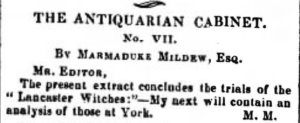
However, the headline revealed that the article was recounting events from much earlier than 1821. The article, written by the wonderfully named Marmaduke Mildew, was the seventh instalment in a series about the Lancaster Witch Trials.
The Pendle Witches and the Bulcock Connection
Mention “Pendle” to most people in the UK, and the immediate association is likely to be “witches”; similarly, “Salem” conjures the same in the US. The infamous Lancaster Witch Trials occurred in 1612 at the assizes in Lancaster Castle. The accused hailed from villages at the foot of Pendle Hill in the Pennines and are now commonly known as the Pendle Witches. Over a two-day trial, ten individuals were found guilty and hanged shortly thereafter.
Among those executed were Jane Bulcock and her son, John Bulcock, both from the village of Newchurch at the base of Pendle Hill. Notably, all of the Bulcocks I had been researching came from villages situated at the foot of Pendle Hill, near Burnley.
Conclusions and Remaining Mysteries
Through this unexpected journey, I have learned far more about the Lancaster Witch Trials than I previously knew, and I have become much better acquainted with the Bulcock families of Newchurch, Downham, Colne, and Padiham. Yet, the mystery remains: I still do not know how these Bulcocks are related to me.
Great blog post – I can definitely relate to the trip down the rabbit hole! Thank you for sharing this.